The IceRays field guide
Your fishing guide
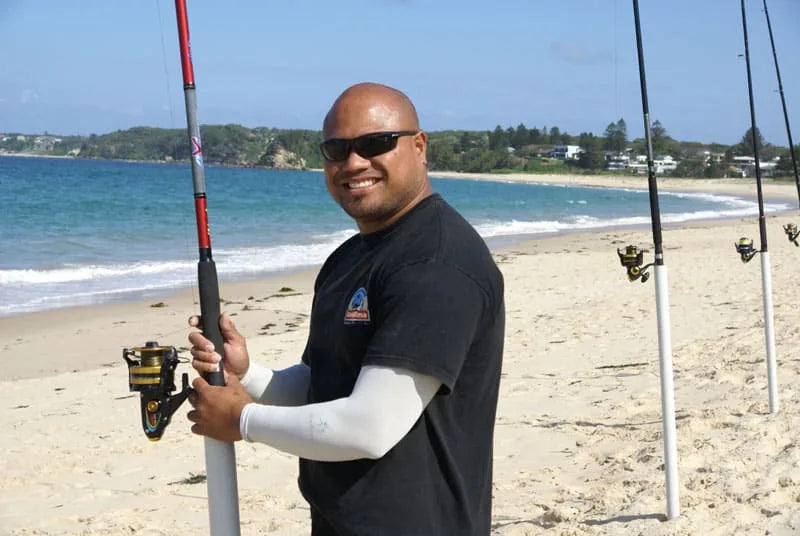
Fishing means hours in one spot, often with no shade at all. Whether you fish off the rocks, the jetty, the beach or a tinny, your arms are out in the sun for most of the session. Sun sleeves are an easy way to keep them covered. Here is how to make them part of your tackle routine, and where their limits are.
Sun from above, and off the water
On the water you get the sun from above and some of it bounced back at you. SunSmart says UV reflects from surfaces around you, like water, sand and concrete. ARPANSA notes that reflected UV can reduce the effect of your other sun protection. A boat canopy or jetty roof helps, but Cancer Council points out that UV can still reach you in the shade by reflection.
Then there is the breeze. A sea breeze can make a hot day feel mild, but it does nothing to the UV. SunSmart says UV, not heat, is the main cause of sunburn, and that the sting people call windburn is really UV damage. If your arms feel cool, they can still be getting plenty of sun.
What sleeves cover
An IceRays sleeve is a thin stretch tube from the upper arm down to the wrist, so it covers the forearm that holds the rod and the one that works the reel. UPF is the sun rating for clothing, the fabric version of the SPF on a sunscreen bottle. At UPF 50+, the fabric blocks 98%+ of UV that lands on it.
ARPANSA tested a black sample of IceRays sleeve fabric in 2015 and rated it UPF 50+ (see the test details (PDF, opens in a new tab)). That rating belongs to the dry black sample. It tells you nothing about the other colours, or about a sleeve soaked by spray or stretched thin.
Sleeves cover your arms only. The backs of your hands, your face, ears and neck still need cover. If you would rather not handle bait and line with sunscreen on your hands, IceRays hand covers sit over the back of the hand with the palm open, so you can still feel the line.
Wet sleeves: what you need to know
Out fishing, sleeves get splashed. Some people dip them in the water on a hot day, because damp fabric can feel cool as it dries in the breeze. That cool feeling is comfort, nothing more, and it is not a promise of lower skin temperature.
Here is the important part. Cancer Council notes that wet fabric gives less protection, and UPF ratings describe dry, unstretched fabric. Our 2015 result is for the black sample as tested. It is not a wet-fabric result. So if your sleeves are soaked, do not treat them as full protection. Swap to a dry pair, and keep your hat and sunscreen in the routine.
We have written up our old wet test video and what it can and cannot show, and a plain answer to whether cooling sleeves work.
Keep sleeves clear of hooks
Sun sleeves are thin stretch fabric. They are not hook-proof or cut-proof, and they will not stop spiky fins or a slip of the knife. Use proper gloves when you handle fish, wire or sharp gear. Never use a sleeve to wrap a hook or hold a fish.
If a hook snags a sleeve, check it for holes before you wear it again. A hole lets sun straight through that spot. A badly snagged sleeve is ready to be replaced.
On the boat and on the rocks
On a boat a sleeve is just another layer of clothing. It never replaces a lifejacket and must never get in the way of one. Try your sleeves on with your lifejacket before you head out. Make sure the cuffs do not catch on rod holders, reels or cleats.
Before a long session, try a few casts in the backyard with no hook on. Check the sleeve stays up when you reach back, and that no strip of skin shows between shirt and sleeve. Snug is right; tight is not. One size fits all adults.
Dawn and dusk sessions usually have lower UV than the middle of the day. If you stay out past mid-morning, the UV climbs. The sun protection times for your spot are on the free SunSmart app.
Pack them in the tackle box
Keep a clean pair in a zip bag in your tackle box or boat bag, away from hooks, knives and bait. A second dry pair is handy for the trip home if the first gets soaked. After the trip, follow the care label, and do not leave salty sleeves balled up in the bag until next weekend.
For regulars, the 4-pack makes sense: four pairs for AUD 120, so $30 each and $31.80 less than four singles. In the US it is USD 100. Pick different colours and hand one to the mate who always forgets a hat.
Tides, bite times and the midday sun
Fish do not read the UV forecast. A good tide or the bite you have waited for can land right in the middle of the day, when UV is usually at its highest. When you plan a trip around the tide chart, look at the UV forecast at the same time and count how many of your hours fall inside the sun protection times.
Land-based anglers can often pick a spot with some shade, such as under a jetty roof or a tree on the bank. In a small boat there is usually nowhere to hide, so cover goes on before you leave the ramp, not when you notice your arms have been out all morning. On long offshore days, take more sunscreen than you think you need and a second dry pair of sleeves for the run home.
Your fishing sun checklist
- Check the UV for the spot you are fishing.
- Sleeves on with dry hands, before you rig up.
- Sunscreen on face, ears, neck and the backs of the hands, or hand covers.
- A hat with a wide brim. Cancer Council's guide is 7.5 cm or more.
- Sunglasses that meet AS/NZS 1067, the Australian Standard. Polarised lenses also cut the glare off the water.
- Gloves for handling fish and sharp gear.
- Water to drink, and a dry spare pair of sleeves.
- Lifejacket on the boat, always.
Watch: putting on a sleeve
Questions and answers
Are sun sleeves still UPF 50+ when they are wet?
We do not claim that. Cancer Council says fabrics protect less when wet, and our 2015 result is for the black sample as tested. If your sleeves are soaked, swap to a dry pair or add other protection.
Will a sleeve protect me from hooks or spiky fins?
No. Sleeves are light fabric, not protective gear. Wear proper gloves and keep hooks clear of the fabric.
Why does a damp sleeve feel cooler?
As water dries off the fabric it can feel cool on your arm, especially in a breeze. It is a comfort feeling only. We do not promise any drop in skin temperature.
Do I still need sunscreen out on the boat?
Yes, on your face, ears, neck and the backs of your hands. Water reflects UV, so a hat and sunglasses matter too.
Do you sell hand covers for fishing?
Yes, in Australia. IceRays hand covers cover the back of the hand and leave the palm free for line and reel. Check the product page for your country.
What size are IceRays sleeves?
One size fits all adults. If they feel tight or keep slipping, contact us and we will help.