The IceRays field guide
Your hiking guide
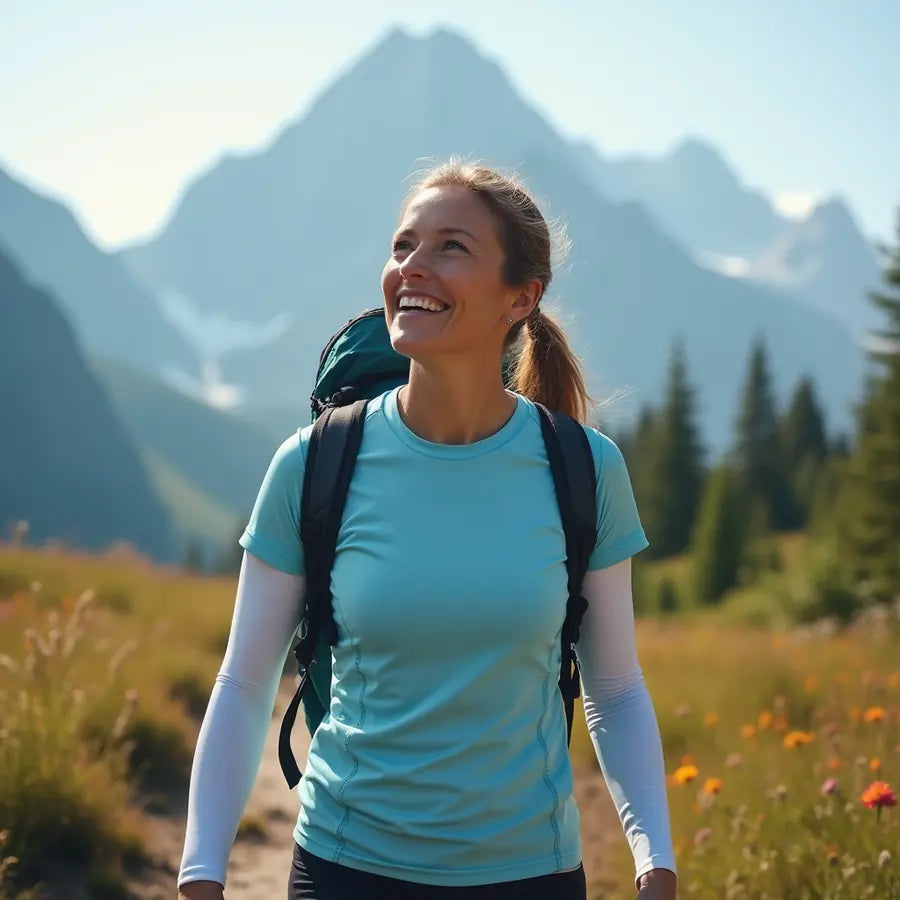
On a bushwalk the shade comes and goes. One minute you are under the gums, the next you are on an open ridge or a fire trail with nowhere to hide. Sun sleeves make it easy to cover your arms for the open stretches, and to take them off when the track drops back into shade.
Why the open track adds up
A day walk can mean five or six hours outside, and a lot of that time is in the open. SunSmart says that if you are outdoors for a few hours, you should use sun protection whatever the UV level, because UV exposure adds up over time.
Height matters too. SunSmart says UV gets stronger by about 10-12% for every 1000 metres you climb, and that light surfaces such as sand and water reflect UV back at you. Cool air at a lookout tells you nothing about the UV. Cancer Council warns that UV can be high even when the day is cool and cloudy.
Plan the walk around the sun
Before you go, look at the map for the open parts of the walk: ridgelines, fire trails, beaches, rock platforms and burnt country where the canopy has gone. Those are the stretches where your arms will be in full sun.
If you can, do the exposed sections early and save the shady gullies for the middle of the day. On a loop walk, pick the direction that puts the open ridge in the morning. On a return walk, remember you will cover the same open ground twice, the second time later in the day, when you are more tired and the UV is higher.
What sleeves do on the trail
An IceRays sleeve is a thin stretch tube from the upper arm to the wrist, light enough to carry all day and wear only on the open sections. UPF is the clothing rating that matches SPF on sunscreen, and UPF 50+ fabric blocks 98%+ of the UV that lands on it.
The fabric was rated UPF 50+ when ARPANSA tested a black sample in 2015 (PDF, opens in a new tab). That covers the dry black sample only. Sweat-soaked fabric, a sleeve dunked in a creek and the other colours were not tested.
Fabric does not need to be put on again every two hours the way sunscreen does. You do have to wear it, though, not leave it in your pack. Sleeves look after your arms only. A hat and sunscreen still need to cover your face, neck, ears and the backs of your hands.
Sleeves on, sleeves off
Slip them on at the trailhead or when you come out of the trees. They are light enough to tuck in a hip-belt pocket when you reach deep shade. Roll the sleeve down to the cuff, slip your hand through and roll it up, then smooth the fabric.
Try them at home with your loaded pack before a big walk. Check:
- The shoulder straps do not push the top of the sleeve down.
- No skin shows between shirt and sleeve when you plant a walking pole or reach up for a handhold.
- The cuff sits at your wrist without bunching under your watch.
Do not pull them so tight that the fabric looks thin. Overstretched knit protects less: ARPANSA's clothing guidance explains that the gaps between the threads open up. Aim for snug, not tight. One size fits all adults.
Warm days, sweat and creek crossings
On a hot climb your sleeves will get damp from sweat, and some people wet them at a creek for a cool feel as the water dries. That is a comfort feeling, with no promise of a lower skin temperature. Read more in do cooling sleeves work?
Wet fabric protects less, Cancer Council says, so on a long day carry a dry spare pair and change into it once the first pair is soaked. SunSmart's advice for walkers is to drink water and rest in the shade. If the day gets too hot for you, cut the walk short. A sleeve is never a reason to push on.
What sleeves will not do on the track
Sleeves are thin fabric. They are not built to stop scratches, prickles, ticks or leeches, and they are no help with snakes. Dress for the track as you normally would. If a sleeve snags on a branch, check it for holes, because a hole lets sun through that spot.
Sleeves snag most on scrambles and narrow, overgrown tracks. If you know a route pushes through thick scrub, a long-sleeved hiking shirt may suit that section better, with the sleeves saved for the open ground either side.
Sleeves are also not a substitute for planning. Tell someone your route, carry enough water, and check the weather and the UV before you set off.
The rest of your sun kit
- A hat with a wide brim. Cancer Council's guide is 7.5 cm or more, and a chin strap keeps it on in the wind on an exposed ridge.
- SPF50 or SPF50+ broad-spectrum, water-resistant sunscreen on the skin left bare, put on 20 minutes before you start.
- Top up your sunscreen at drink breaks and in shady spots, at least every two hours.
- Sunglasses that meet AS/NZS 1067, ideally a wrap-around style for glare off sand, rock and water.
- An early start. SunSmart suggests heading off early or walking later in the day, when UV is lower.
Colours, spare pairs and value for walkers
There are six colours: Charcoal, Beige, Light Grey, White, Light Blue and Black. Charcoal and Beige hide trail dust, while White and Light Blue look bright on a sunny ridge. On UV, the same fabric in a darker colour usually absorbs more than a pale one, Cancer Council notes, and black was the only colour in our 2015 test. Our page on whether colour matters explains it.
A pair is two sleeves. On overnight and multi-day walks, carry a second pair so one can dry on the outside of your pack while you wear the other. Wash them when you get home, following the care label.
The 4-pack is four pairs for AUD 120, so $30 a pair and $31.80 less than four singles. In the US it is USD 100. Mix the colours and share a pack with your walking group.
Watch: putting on a sleeve
Questions and answers
Should I take sleeves off in the shade?
You can in deep shade. UV still reaches you through gaps in the trees and by reflection, so leaving them on is the easy option.
Is UV stronger on a mountain?
Yes. SunSmart says UV rises by about 10-12% for every 1000 metres you climb. Cool air at the top does not mean low UV.
Do sleeves still protect when they are sweaty or wet?
Cancer Council says fabrics protect less when wet. Our 2015 result is for the black sample as tested, not wet fabric. Carry a dry spare pair on long or hot walks.
Will they slip under my pack straps?
Try them with your loaded pack on a short walk first. If a strap pushes the sleeve down, pull it back up and smooth it. Contact us if they keep slipping.
Do I still need sunscreen on a hike?
Yes, on your face, ears, neck and the backs of your hands. Top it up at least every two hours.
What size are IceRays sleeves?
One size fits all adults.